![[High-Gloss SVBRDF Capture Using Bounce Light]](iser2026highgloss-400x300.jpg)
Tomáš Iser1,2, Andrei-Timotei Ardelean1, Tim Weyrich1
1 Friedrich-Alexander-Universität Erlangen-Nürnberg (FAU)
2 Charles University
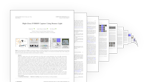
Reflectance capture aims at the visual reproduction of an object under varying illumination. Past works differ substantially in their experimental overhead, from single- or few-image approaches, that employ significant (often learned) priors at the expense of biased reconstructions, to more accurate approaches that tend to be time-consuming, which to a good part is due to the need for carefully controlled illumination. Moreover, as we will show, the frequently employed point-light or directional lighting tends to clip highlights and under-sample the reflectance of glossy surfaces, leading to incorrect reconstructions under previously unseen illumination. Our work aims to strike a new balance, combining a low-overhead capture methodology with a fast (neural) model fit. A key feature of our approach is the use of handheld, indirect bounce light that enables a convenient capture methodology, limits the dynamic range of the reflectance (effectively avoiding highlight clipping) and ensures contiguous hemispherical incidence, even with few images, eliminating under-sampling of highly specular reflectance lobes. Moreover, our approach does not require training on pre-existing material datasets and thus is not restricted by the choice of dataset, and its inference scales linearly with the number of pixels, scaling exceptionally well to large image sizes. As a result, our method enables high-resolution capture of a spatially-varying reflectance distribution function (SVBRDF) from a small set of casually captured, indirectly lit photographs, making high-quality material acquisition practical even on consumer hardware. Overall, we believe that our method occupies a unique trade-off between acquisition effort, model assumptions and resulting quality, and it has the potential to transform areas that routinely use handheld point-light sources, such as the popular reflectance transformation imaging (RTI), leading to more faithful reproductions of artefacts and their surface characteristics.
Tomáš Iser, Andrei-Timotei Ardelean, Tim Weyrich. Computer Graphics Forum (Proc. Eurographics), 45(2), 15 pages, May 2026.Tomáš Iser, Andrei-Timotei Ardelean, and Tim Weyrich. High-gloss SVBRDF capture using bounce light. Computer Graphics Forum (Proc. Eurographics), 45(2), May 2026.Iser, T., Ardelean, A.-T., and Weyrich, T.2026. High-gloss SVBRDF capture using bounce light. Computer Graphics Forum (Proc. Eurographics) 45, 2 (May).T. Iser, A.-T. Ardelean, and T. Weyrich, “High-gloss SVBRDF capture using bounce light,” Computer Graphics Forum (Proc. Eurographics), vol. 45, no. 2, May 2026. |
This project has received funding from the European Union's Horizon 2020 research and innovation programme under the Marie Skłodowska-Curie grant agreement No 956585. This work was further supported by the Charles University grant SVV-260822. Open Access funding enabled and organized by Projekt DEAL.